

Why understanding the price-value relationship matters
In professional services, price is never just a number. It’s a signal and often a shortcut for assessing value. Yet many firms are setting or defending their prices without fully understanding how their value is perceived by clients.
This disconnect can lead to under-pricing, over-discounting, or delivering services that don’t align with client expectations. All of this erodes profitability and trust.
At Beaton, we’ve spent decades researching how clients experience professional services and how their perception of value shapes their response to price. What we’ve consistently found is this: clients don’t evaluate price in a vacuum. They interpret it through the lens of their experience, and how well they feel understood, supported, and guided toward results.
In this article, we explore the psychology behind pricing, what drives perceived value, and how firms can build pricing strategies based on what clients truly care about – not just what they’re willing to pay.
The psychology of pricing in professional services
Professional services pricing is more than a financial transaction; it’s a psychological cue. Unlike product pricing, where customers can immediately evaluate what they’re getting, the value of professional services is often intangible and revealed over time. This makes pricing a powerful, and sometimes risky, lever affecting how clients perceive your firm.
Price as a heuristic for value
Beaton Benchmarks research over more than 20 years has shown clients interpret price as a signal of quality and value. That is – when clients see higher prices, they assume the service is better. This is particularly so when they lack other ways to judge service outcomes. In the absence of other tangible benchmarks, clients are already using price to assess your firm’s service quality.
Behavioural research has long shown the impact of price on perceived value in business-to-consumer industries. According to Nobel laureate Daniel Kahneman and economist Richard Thaler, people rely on heuristics – mental shortcuts – to make decisions under uncertainty. Price becomes one such shortcut: a higher fee suggests a higher-calibre provider. A lower price, on the other hand, may imply inexperience or lower quality, even if the actual service is strong.
This psychological phenomenon has been widely observed in studies of business-to-consumer (B2C) industries. We like to call it the “designer handbag effect” – where shoppers expect the most premium designer handbags to cost thousands, and a lower price may cause them to think they’re buying a cheaper and therefore lower quality substitute. Our research shows the same effect applies in B2B professional services, under the right circumstances (which we will outline below).
In professional services, a higher price can signal higher quality of service, greater expertise in the firm, or stronger outcomes. This is especially true when clients are engaging a firm for the first time, or when the service is complex or difficult to evaluate.
Ironically, discounting your fees to win work can have the opposite effect – reducing your perceived value and positioning your firm as less capable or less confident in its offering.
“There’s a psychology in how people connect price with perceived expertise. If you’re cheaper than other options, you can lose credibility,” explains Libby Maynard, partner at Beaton and professional services pricing expert.
“If a client sees high quality and confidence, they expect a higher price. Low price can signal lower quality or a misunderstanding of what’s required to deliver the desired outcome.”
The “designer handbag effect” describes the phenomenon where shoppers expect the most premium designer handbags to cost thousands. Meanwhile, a lower price may cause them to think they’re buying a cheaper and therefore lower quality substitute.
If a client sees high quality and confidence, they expect a higher price. Low price can signal lower quality or a misunderstanding of what’s required to deliver the desired outcome.
Libby Maynard, Beaton partner
Clients perceive prices are declining
Beaton’s data over the past two decades reveals that clients perceive average price levels have been declining across professional services. This means that while the actual dollar price may have increased over time, the perception among clients is they are paying less in relative terms for the same work. At the same time, their perceived value of that work has been rising. This is a telling reflection of the increased focus on lifting client service and competition in the increasingly crowded professional services market. Firms are competing more than ever to be more efficient and profitable against their competitors.
In practice, while firms face pricing pressures from such heated competition, discounting to compete can backfire because of the association between price and quality. Clients may start to question whether the service is high enough quality to be worth their investment. Conversely, setting prices too high – without a clearly communicated value proposition – risks alienating clients who don’t see the justification.
“If you don’t create some form of differentiation or some reason why a client should choose you over the competition, then they will just choose on price,” says Maynard.
Firms must aim for a “Goldilocks Zone” – an optimal price range that feels just right. It should be high enough to signal expertise, confidence, and quality service but not so high that it appears to be unfair or reduces trust.
The challenge of intangibility
Professional services pricing is also shaped by emotion and risk perception. High-stakes services (like complex legal advice or financial audits, or engineering feasibility reports) often carry significant consequences. In these situations, clients aren’t just evaluating fees – they’re assessing risk, reassurance, and potential outcomes. They’re paying for the confidence and trust that their projects will be handled expertly for them.
“Clients won’t actually be comparing apples with apples,” says Maynard.
“The scope may be the same, but there will be other things that are not always mentioned, such as: ‘Do I have confidence in this firm? Do I think that they’re honest? Do I think they’re trustworthy? Do they make my life easy?”
A high price can reinforce confidence if it aligns with a compelling value narrative. A low price may signal uncertainty or lack of capability. The emotional context of a purchase – such as reducing risk or protecting reputation – can outweigh purely rational price comparisons.
To complicate things, professional services are, by nature, intangible. Clients often don’t experience the full impact of your work until long after delivery. Frequently, firms direct clients away from costly risks, yet because the negative outcome never materialises, the value of this advice can go unrecognised.
This delayed or unrecognised value makes price perception more emotionally charged and susceptible to psychological dynamics. Maynard recommends overcoming this obstacle by demonstrating understanding of the client’s business, proactively showing them how you might resolve issues and providing options.
“This often favours an incumbent, but there are ways of building credibility even if you don’t have a history of working with the client,” says Maynard.
“It’s important to remember that client experience doesn’t just start when the engagement starts, it starts well before the engagement. So – what experience has the client had with this firm before they even started using them? Being curious about their business, asking great questions and sharing valuable ideas is a great way to position as a credible and valuable service provider.”
It’s important to remember that client experience doesn't just start when the engagement starts, it starts well before the engagement ... Being curious about their business, asking great questions and sharing valuable ideas is a great way to position as a credible and valuable service provider.
Libby Maynard, Beaton partner
What drives perceived value?
It’s tempting to assume your clients’ perceived value is judged on outcomes alone. And while results do matter, Beaton’s research shows that perceived value is built long before results are delivered. It’s shaped by how clients feel about their experience, how well they understand the service, and how confident they are in their provider.
Our research surveys thousands of clients every year across all professional services industries, offering rare clarity on this topic. Across more than two decades of benchmarking, our analysis reveals that perceived value isn’t random or mysterious – it can be explained and influenced.
The 11 attributes we study in firms through Beaton Benchmarks explain around 70 per cent of the variation in how clients perceive value. These are illustrated in the chart below.
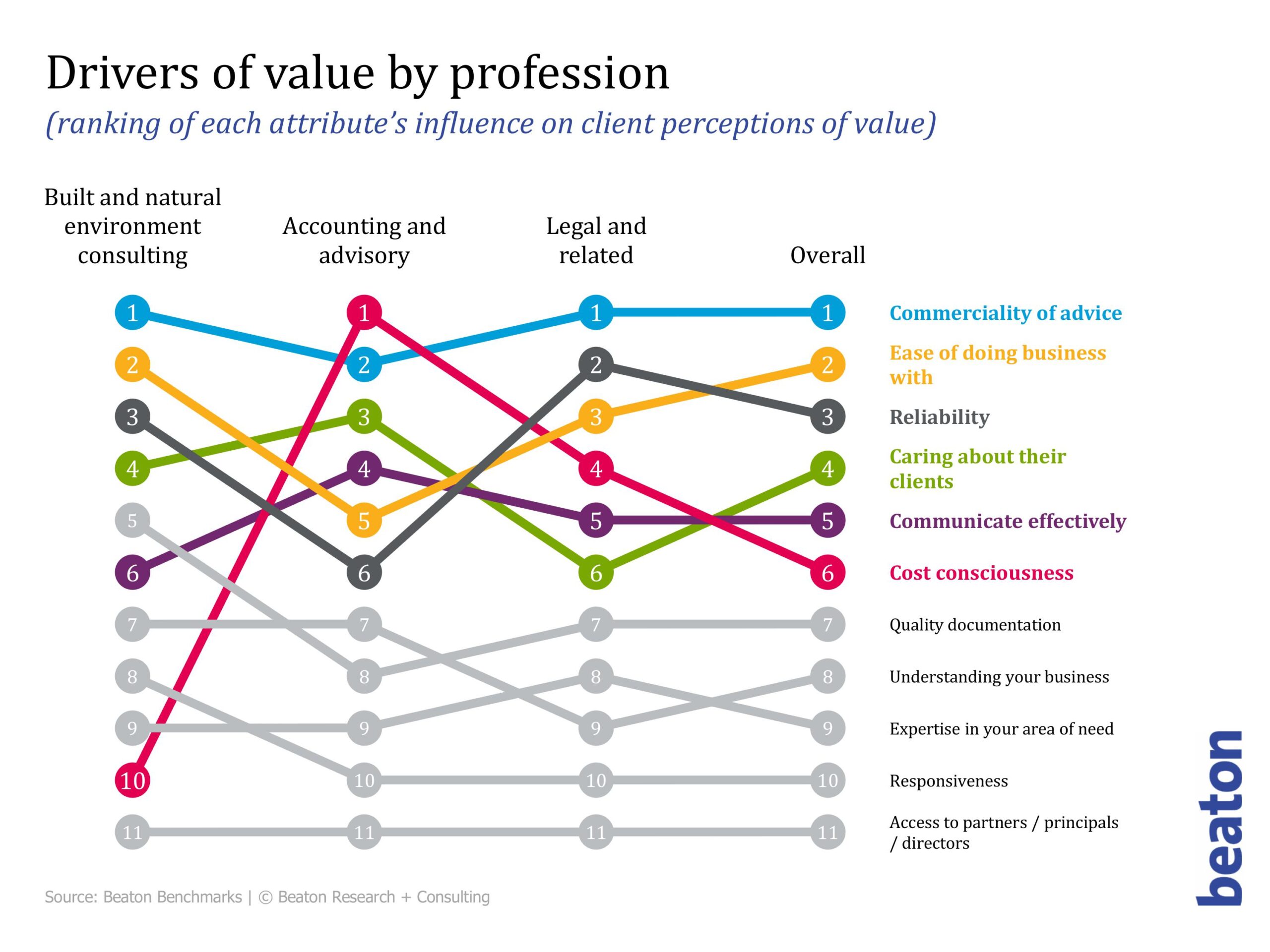
These insights give firms a clear roadmap for shaping stronger value propositions and supporting value-based pricing strategies.
The top drivers of perceived value
From the chart you’ll notice five key attributes drive are consistently high across the professions. The surprise? None of them are expertise in clients’ area of need.
The top five drivers are:
- Commerciality of advice
- Ease of doing business
- Reliability
- Caring about the client and their outcomes
- Effective communication
Interestingly, cost consciousness varies depending on the firm’s industry. It is the single top driver for clients of accounting and advisory firms while near the bottom for built and natural environment consulting firms.
Technical expertise is a given
It may surprise some leaders to learn that expertise in clients’ area of need ranks near the bottom in terms of value drivers in our research. Why? Because technical skill is assumed. In the client’s mind, it’s the bare minimum required to be in the running for their work. It’s not what sets one firm apart from another, and it doesn’t carry much weight in justifying a premium.
“Expertise in your area of need is not enough – it’s just the ticket to play. Clients assume you’ve got it,” says Maynard.
“The thing that firms often think of as their strength – technical skill – is actually not a differentiator. It’s a minimum expectation.”
Value is in the eye of the client
Perceived value is subjective at its core. It’s not just about what you deliver, it’s about what the client believes they’ve gained in return for what they’ve paid. That belief is influenced by multiple factors that act as drivers of perceived value.
From the above research we can distil several common themes across industries about what clients value from their providers:
- Clear communication – Clients value clarity on process, scope, and progress
- Responsiveness – The speed and tone of communication builds trust
- Tailored advice – Generic recommendations erode value perception; bespoke guidance enhances it
- Commercial understanding – Clients want to feel that you “get” their business and their goals
- Consistency and team cohesion – Value is diluted when service feels disjointed or staff turnover is high
These aren’t just “soft skills”, they’re central to the way clients assign worth to a service. Clients often assess these before they evaluate technical accuracy or final outcomes.
“A practitioner who can connect with their client, who really listens, who makes them feel understood and more importantly, can manage their expectations as to scope budget and outcomes – that’s the person they’ll go back to, even if someone else is technically just as good,” says Maynard.
“Because the technical skills can be hard to measure, the non-technical experience is absolutely what makes the difference between ‘okay’ and ‘exceptional’ in the eyes of the client.”
These non-technical factors reflect what clients really care about in day-to-day interactions: great project management, seamless collaboration, strategic understanding, and feeling like their advisor is genuinely invested in their success.
This has big implications for pricing strategies. These drivers give firms levers to influence perceived value, which in turn supports price-setting discretion – the ability to set and defend fees confidently, based on differentiated client experience.
Value is in the eye of the client – so communicating your firm’s value well is crucial to establishing and justifying higher prices.
The big mistakes made in professional services pricing
Understanding the price-value relationship has real consequences for profitability, client loyalty, and market positioning. In professional services pricing, there are two common mistakes we see.
Mistake 1: Competing on lowest price
The most common mistake is a firm undervaluing its service – often out of fear of losing business. In this scenario, firms default to competitive pricing tactics or excessive discounting because they believe that lower prices will attract or retain clients.
But Beaton’s research shows these tactics can have the opposite effect. Perceived value and price are deeply intertwined – and when prices are too low, clients may question the quality or strategic importance of the service. Rather than seeing it as a “good deal,” they may perceive it as low-value or commoditised.
Mistake 2: Failing to articulate value
If the client doesn’t understand how a service has or will help them achieve their goals, they’re more likely to challenge invoices, dispute variations or express dissatisfaction, even if the technical work was flawless. They’ll assume they are being overcharged because they aren’t certain of how their money was spent or their expectations weren’t managed.
Without clear communication (early, often, pre- and post-delivery) even premium services can appear overpriced.
So, what should you do instead? The value you provide must be clearly articulated to the client. And not just in the final deliverable, but in how you engage, explain, and reinforce the work you are doing throughout the project. Communicating and demonstrating cost consciousness aren’t simply nice-to-haves; they are central to the perceived value of your service and the sustainability of your pricing strategy.
We explain how via the six-step process below.
Because the technical skills can be hard to measure, the non-technical experience is absolutely what makes the difference between ‘okay’ and ‘exceptional’ in the eyes of the client.
Libby Maynard, Beaton partner
Building a value-based pricing strategy (with steps on how)
The best pricing strategy in professional services switches your clients’ focus away from dollar figures so you are no longer competing in a “race to the bottom”. Ideally, you will position your firm as “one of one”: a unique provider offering such valuable service that clients cannot compare yours to other firms based on price alone.
Value-based pricing in this way empowers firms to move away from reactive discounting and toward pricing with confidence. It demands a clear understanding of your clients, your value proposition, and the market offering compared to your own.
Here’s a step-by-step guide to building a value-based pricing strategy that reflects your worth – and helps clients see it, too.
1. Understand what clients truly value in client service
You’ll need to start with evidence, not assumptions. Use client feedback surveys, NPS, or depth interviews to identify what clients want and value most from your firm. Beaton Benchmarks measures the drivers of perceived value in professional services firms annually and provides a robust standard to compare your own firm to.
Look for patterns in what clients are highlighting as most valuable. Is it responsiveness? Industry understanding? Clarity of advice? Our research shows clients value the experience they have when they engage with a firm far more than technical expertise which is a given, and less of a differentiator.
Focus your approach on measuring and improving these drivers, not just your work inputs or costs.
2. Design pricing around outcomes, not hours
Further to the point above, it can be useful to detach your prices from effort or time. While time-based billing is still a common way to charge for professional services, clients tend to be more receptive when a price reflects the value of the solution provided. To them, the mechanics of how it’s delivered is less relevant.
For example:
- Link the value to a business outcome such as reducing a business cost, reducing or removing a business risk, growing client revenue and profit or building or protecting the client’s brand.
- Where possible, quote for fixed-fee packages tied to specific deliverables
- Offer tiered pricing based on levels of strategic impact
- Consider success-based pricing for advisory or transformation projects
- Offer pricing options – so that the client chooses between one of your options rather than your option and a competitor option
This shifts the conversation from “how long will it take?” to “what is it worth?”
3. Communicate value early and often
A value-based price won’t stick unless the client clearly understands what they’re getting. Throughout your proposal, onboarding, and delivery stages, reinforce the connection between your service and the value delivered by reference to the client’s goals.
Use language that connects with outcomes, risk reduction, and strategic alignment. Avoid jargon that makes your work harder to understand. Your job is to make the value behind the price unmistakably clear. Quantify the business outcome in dollar terms if you can.
4. Enable your people to have confident pricing conversations
A pricing strategy is only as strong as the people delivering it. Equip your partners, account managers, consultants or lawyers with tools and messaging to explain pricing confidently and handle objections or discounting with empathy and clarity, not panic.
Confidence, combined with clarity, is one of the most effective ways to reduce unnecessary discounting.
5. Review, test and refine
Pricing is not a “set and forget” process. Continuously review what’s working, where pushback is occurring, and whether certain client segments respond better to different pricing models. Track client sentiment and monitor the market to understand how your prices compare to similar firms. Use automated client feedback surveys at various points throughout a project to understand how clients feel about everything – including your price.
Stay responsive, but not reactive.
Final thought
Value-based pricing isn’t about charging more for the same thing. It’s about delivering a service that clients genuinely value – and making sure they understand, experience, and are willing to pay for that value.
Get insights and market trends delivered to your inbox
Sign up to our monthly newsletter and get the latest updates and insights from Beaton’s research.