

Even in the most innovative professional services firms, many of the ways we gather feedback are often surprisingly old-fashioned. Conversations over coffee, follow-up calls, and personal emails are all examples of manual feedback processes that play a vital role in relationship-building and client listening.
These moments create trust, show care, and can reveal valuable qualitative insights.
But when manual feedback is the only approach, it becomes difficult to maintain consistency and scale. These manual feedback processes are often time-consuming, prone to human error, and difficult to analyse in a structured way. Over time, this creates client feedback inefficiencies that slow decision-making and leave valuable insights untapped.
That’s why leading firms are blending the personal connection of manual feedback with feedback automation for professional services. Automated systems and structured surveys complement, rather than replace, human conversations. They capture consistent, data-driven insights across clients, projects, and offices. This balance allows firms to strengthen relationships while improving efficiency, accuracy, and their ability to act on what clients really think.
When to use manual feedback
Before we go further, it’s important to understand the use of manual vs automated feedback isn’t an either/or choice. Even as automation becomes essential for efficiency, consistency and scale, catching up with clients in person or over the phone still plays a critical role – particularly for key clients or high-value projects. Direct conversations provide depth, context, and nuance that structured surveys alone can’t capture, making them a vital part of a modern, data-informed feedback strategy.
As Beaton partner Paul Hugh-Jones points out, these high-touch interactions signal care and attention, help strengthen relationships, and allow you to pick up on subtle issues before they escalate.
“We encourage firms to be having regular feedback conversations with important clients,” says Hugh-Jones.
“The more important a client, the more they will expect you to take time to have a conversation and say do you want to talk about the relationship and what’s happening? Ideally you do this face-to-face and, if not, virtual. It’s a high service point that signals you really care about their business, and it’s where an email or survey on its own wouldn’t cut it.”
The key is knowing when to invest in these conversations, rather than relying on them as your default feedback method. Use them when the client is strategically important and you want to strengthen the relationship rather than just collect data. In this case, the feedback opportunity doubles as a touchpoint.
Asking your key clients for feedback individually sends a strong message you care and enables you to notice challenges before they escalate.
The costs of manual feedback processes
When we first talk to firms about client feedback, a familiar pattern emerges. Many believe that their quick chat over the phone or a follow-up email provides enough insight into client satisfaction. While these manual feedback processes can build rapport and uncover valuable qualitative detail, they often fall short when it comes to capturing data that’s consistent, comparable, and actionable.
Recent research underscores this challenge. This 2025 report found that 87 per cent of customer experience (CX) leaders still rely on manual analysis of open-text feedback. The typical workflow involves sending surveys one by one, downloading responses, and manually tagging comments in Excel. By the time this manual feedback is compiled into a report, the opportunity to respond, or turn insight into action, has often passed.
We’ve seen the risks of inefficient client feedback systems play out in other sectors, too. A national review into the National Disability Insurance Scheme (NDIS) revealed how reliance on manual note-taking led to missing client information, inconsistent documentation, and feedback that couldn’t be acted on. The underlying issues – heavy workloads, outdated systems, and disconnected processes – created a perfect storm of client feedback inefficiencies that wasted time and resources. Professional services firms face many of the same risks when feedback relies on memory, spreadsheets, and goodwill rather than structure.
As Hugh-Jones explains, the problem often isn’t a lack of feedback – it’s a lack of consistency.
“In many firms, feedback is collected in an ad-hoc manner, with different people using different methods and tools. This lack of standardisation can lead to inconsistent data and make it difficult to draw meaningful conclusions,” he says.
Firms that continue to depend solely on manual approaches risk missing the full picture. The goal isn’t to abandon personal conversations, but to complement them with systems that make client listening more reliable, efficient, and evidence-based.
Accuracy problems with manual feedback
Exclusively using manual feedback isn’t just costly – it builds a lopsided picture and a skewed reflection of your service. Experiences from one or two clients rarely give a full or accurate picture. For example, notes from a client lunch might capture one person’s perspective but would not account for every individual’s feelings across a project or an office.
The subjective nature of manual feedback processes can introduce biases. Factors such as the feedback provider’s relationship with the client, the setting of the conversation, and the manner in which questions are posed can all influence the responses. These biases can distort the true picture of client sentiments and needs.
“If the person gathering the feedback has a close relationship with the client, the client might be less candid, or they might tailor their responses to what they think the provider wants to hear,” says Hugh-Jones.
The way questions are framed during feedback sessions can also guide clients toward certain types of responses. Leading or suggestive questions can result in feedback that doesn’t accurately reflect the client’s true feelings or experiences. It might help you to avoid complaints, but as this article describes, avoiding complaints might be the worst thing a professional services firm can do. You may also be acting on data that misrepresents client needs and satisfaction levels.
The accuracy problems with manual feedback stem from:
- Inconsistencies in delivery and analysis: Without standardised questions or formats, it’s impossible to compare insights across clients, projects, or offices. What one partner hears in a conversation might be very different from what another hears, even about the same engagement.
- Human error and bias: As humans, we naturally filter feedback through our own experiences and assumptions. That means important signals can get lost, while minor complaints loom larger than they should.
Automated feedback processes can obtain broader insights across many clients or projects, using metrics like Net Promoter Score.
Manual vs automated feedback solutions
Automated feedback refers to a structured, technology-enabled process for collecting, analysing, and reporting client feedback. Unlike manual feedback processes, which rely on informal or ad hoc methods, automated feedback uses digital tools to deliver surveys, capture responses in real time, and generate actionable insights through dashboards or reports.
Automated feedback may draw shallower insights – as it can be hard to empathetically tease out the full picture of a client’s feelings or frustrations through a screen in the same way you may would though face-to-face conversations. However, the insights will apply to a broader audience of clients and may more accurately reflect the zeitgeist in your client pool (rather than the feelings of one or two).
A key benefit of automation is greater consistency through using carefully designed, repeatable questions that cover the key aspects of service quality, value, and satisfaction. It enables feedback analysis automation, reducing the time spent compiling data and allowing your team to focus on action. It also supports comparing feedback collection methods more effectively, showing which approaches yield the most meaningful insights.
Automation also reduces human bias by removing interpersonal pressure. There’s a lot that may influence the tone of a conversation or expectations in a face-to-face interview. The neutrality of automated surveys encourages clients to feel more comfortable being frank and honest.
Finally, the ease and speed of follow-up is a big differentiator for automated feedback. These systems trigger reminders and track completion – ensuring action without requiring repeated outreach by busy staff.
In summary, use automated feedback surveys when:
- You need broad, consistent insights across many clients or projects.
- You want actionable metrics that are easy to compare and benchmark over time.
- Time or resources make one-on-one conversations impractical.
- You’re seeking quick, real-time feedback to inform operational decisions.
Use manual feedback conversations when:
- The client is strategically important or high-value. A direct discussion shows you care and builds trust.
- You need nuanced, qualitative insights that surveys can’t capture – tone, emotion, context, or subtle concerns.
- There’s a complex issue or project that requires deeper understanding, clarification, or problem-solving.
- You want to strengthen relationships rather than just collect data – the feedback opportunity doubles as a touchpoint.
In short: surveys are for scale and measurement, conversations are for depth and relationship-building. The best feedback programs effectively use both.
Outsourced feedback solutions
While automated feedback gives firms consistency and scale, some choose to go a step further by evaluating whether to build or buy a feedback solution. Partnering with an external provider to manage the entire process – from survey design and distribution to analysis and reporting – is often the more effective route.
Outsourced client feedback solutions can be especially valuable for firms that want high-quality insights without burdening internal teams. Unlike manual or even internally managed systems, internal vs outsourced feedback models show that external programs provide independence and credibility. Clients are often more candid with neutral third parties, improving reliability.
“Providing feedback to a third party removes the pressure of an immediate response and encourages more honesty,” says Paul Hugh-Jones.
“The more candid the responses, the more useful the insights become, which allows firms to make meaningful changes rather than relying on assumptions.”
Key advantages of outsourcing feedback include:
- Reduced internal disruption: Staff aren’t diverted from client work or bogged down in admin tasks like sending reminders, compiling responses, or coding comments.
- Expert survey design: Outsourced providers bring expertise in crafting questions that are clear, unbiased, and tailored to capture actionable information. This ensures you’re using the best feedback methods for firms rather than guessing what will be useful.
- Consistent comparison: External providers can help compare your results across time, offices, or even the broader industry, helping you identify trends and set targets.
- Deep insights: With professional analysis, feedback is not just collected – it’s interpreted, highlighting key risks, opportunities, and priorities for action. This is especially important when you’re looking to act on feedback and make decisions informed by robust data.
- Scalability across clients and service lines: Outsourced programs can handle large volumes of feedback across multiple projects or offices, something that is difficult with manual or automated feedback alone.
Real-world examples by industry
Law
McCullough Robertson, a leading Australian law firm, faced challenges with their manual feedback processes, which were inconsistent and inefficient. The firm relied on ad-hoc methods to gather client feedback, leading to a lack of structured insights.
The firm implemented an automated client survey tool, Beaton Debrief, to collect and organise client feedback via online surveys with responses collected in an intelligent dashboard. This system outsourced the survey design and setup to research experts, taking the admin work out, while keeping feedback easily accessible and actionable.
The firm improved its Net Promoter Score (NPS) by 14 points and grew client care scores by 30 per cent.
Engineering and design consultancy
Harrison Grierson, a New Zealand-based engineering and design consultancy, also faced challenges with their manual feedback processes, which were haphazard and lacked coordination. The firm previously used multiple tools, leading to fragmented feedback collection and low response rates.
After implementing Beaton Debrief, an automated survey tool that outsources survey design and administrative setup, the firm noted remarkable improvements on a range of metrics. It increased its NPS by 15 points, client satisfaction scores improved by 18 per cent, and responsiveness scores from clients rose by 24 per cent. The firm has also reported an enhanced culture of client-centricity, in which all team members feel empowered to make impact.
Beaton Debrief is an automated, outsourced feedback solution that is built and tailored for your needs by research experts.
Addressing common objections
Even when firms understand the value of client feedback, several common objections often slow down adoption. While these concerns are understandable, they often overlook the hidden costs and missed opportunities of relying on manual processes or inconsistent methods. In most cases, thoughtfully designed surveys, automated systems, or outsourced programs can overcome these barriers – improving response rates, revealing hidden insights, and freeing your team to focus on high-value client work.
Here are some common objections we hear when client experience teams try to implement feedback solutions – and suggestions for how to address them.
1. Our clients are too busy to respond.
Many clients are happy to provide feedback if you communicate the reasons and timing of the survey. Tell them you will use it to improve services for them and their feedback is valued. Additionally, good survey design and timing significantly increase response rates.
“A lot of partners say, ‘Our clients are too busy to give feedback.’ But the reality is, most clients aren’t being asked regularly – and when they are, they’re usually happy to share because it shows you care,” says Hugh-Jones.
2. We already know what our clients think.
Anecdotal knowledge often overestimates relationship strength. Structured feedback reveals hidden dissatisfaction and unmet needs.
“People assume they already know how their clients feel because they speak to them often, but that’s dangerous. You might only be hearing from one person or one perspective – and it’s often the positive one,” says Hugh-Jones.
3. We can’t afford a feedback solution right now.
In reality, the cost of inefficiency, wasted staff time, and missed opportunities usually exceeds the investment in automation or outsourcing.
“If you lose even one major client because you didn’t pick up on an issue early enough, that’s far more expensive than investing in a proper feedback program,” says Hugh-Jones.
4. We’ll handle it internally.
Manual internal processes are resource-intensive, prone to inconsistency, bias, and disruption to client-facing teams, limiting value.
“It can be powerful to handle the feedback process internally, but that might involve 20 hours of conversations and days of travel. Whereas the client feedback can be run by professionals who focus on it – that’s all they do. It’s going to be more efficient, you’re more likely to get structured answers,” says Hugh-Jones.
What to look for in a feedback survey solution or partner
Choosing the right feedback survey system or partner can make the difference between a process that feels like admin and one that truly drives improvement. When assessing your options look for features that enhance both efficiency and insight.
When choosing a system, prioritise:
- Survey design expertise – Look for providers who understand professional services and can craft clear, unbiased questions that produce actionable insights. Strong design underpins the best feedback methods for firms, ensuring results you can trust.
- Customisation options – Every firm and client base is unique. Your system should allow flexibility to tailor surveys by service line, client segment, or project type, avoiding one-size-fits-all inefficient client feedback.
- Data privacy and client confidentiality – Ensure your provider meets strict privacy and ethical standards so clients feel confident sharing honest feedback.
- Feedback analysis automation – Automated reporting and dashboards save time, reduce errors, and allow teams to act on insights faster, removing common client feedback inefficiencies.
- Support for internal action planning – Insights only matter when they lead to change. The right partner will help your teams interpret results, plan improvements, and embed learnings into daily practice.
Try our feedback solution: Beaton Debrief
For firms looking to overcome client feedback inefficiencies, we built Beaton Debrief as a unique end-to-end solution. It offers the best of both worlds in both automated and outsourced feedback solutions, allowing professional services firms to spend less time on admin and more time acting on the data received. With options to customise surveys for your clients and send them at various points in the project lifecycle, and surveys designed by our expert researchers, it supports your success by maximising the return on your investment.
Explore how Beaton Debrief can transform your feedback process and deliver consistent, actionable insights for your firm: Beaton Debrief.
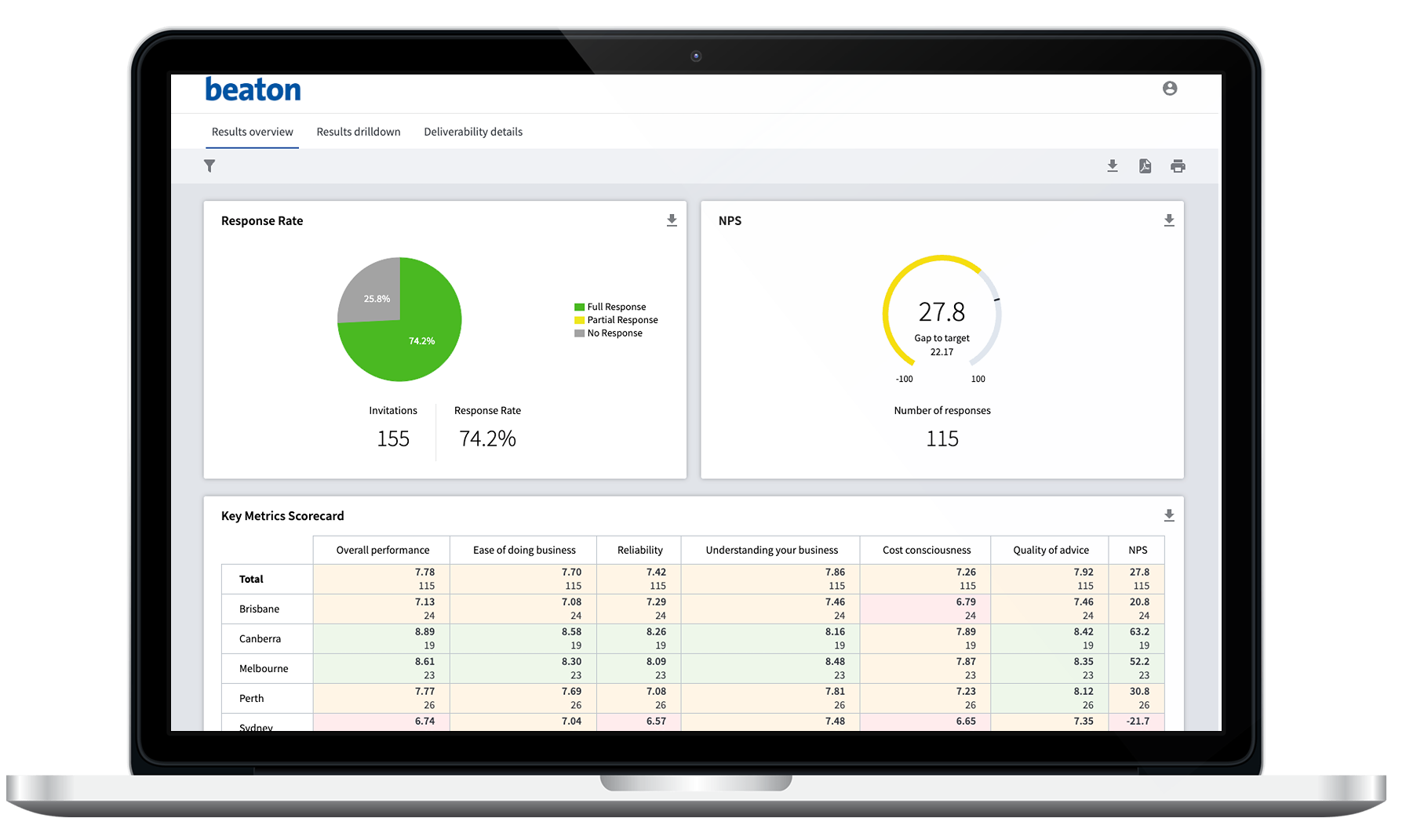
A screenshot of the Beaton Debrief dashboard.
Conclusion
Client feedback has become one of the most valuable sources of intelligence in professional services. But when firms depend solely on manual feedback processes, they often pay for it in inefficiency, missed opportunities, and inconsistent insights. Conversations and relationships will always matter – they are the foundation of trust and understanding – but they can’t stand alone as a feedback strategy.
By combining manual listening with feedback automation for professional services or outsourced client feedback solutions, firms can achieve the best of both worlds: human connection backed by structured, data-driven insight. This balance leads to faster analysis, deeper understanding, and more confident decision-making – all while freeing up valuable time and resources.
Download our free guide to client feedback surveys
Learn how leading firms turn client feedback into measurable growth. Download our guide to client feedback surveys with 12 best-practice recommendations for professional services firms.
